
UnBox For Self-Directed Learning
A hands on fun experiment in Jammu & Kashmir
Khushi Kesari and Farheen, Sanrachna Foundation For SoC Education LLP
Under the aegis of SCERT-JK and JKBOSE

Introduction
What is UNBOX
The UNBOX is a specially designed toolkit by SoC Education LLP that aims at "Self-Directed Learning" and offers children meaningful experiences that help them nurture the connection with themselves. The toolkit is designed to allow students to create novel ideas and solutions to various problems. UnBox is for kids between the ages of 3-10. Using art as a medium, it contains openended exercises of arts, called कला -कसरत, which are designed meticulously to meet the most fundamental needs of learning for varying age groups.


The UnBox toolkit and its various components.
Understanding the Idea Behind the UnBox toolkit and its contents
The UNBOX sees creativity as the ability to generate new ideas and solutions, distinct from innovation and discovery. It involves novelty and appropriateness. While children naturally explore and make sense of the world creatively, societal norms often stifle this creativity as we grow up. However, embracing one's inner voice and exploring the atypical can foster creativity. A substantial body of research - qualitative, mixed-methods, and quantitative - supports the theory that engagement with the arts can contribute to positive outcomes in diverse spheres, including academic achievement, professional success, social behaviour change, and social transformation, not to mention health benefits and general well-being (Deasy, 2002; Ewing, 2010; McLellan et al., 2012a, 2015; Winner et al., 2013; Fancourt and Finn, 2019). Research at the Johns Hopkins University School of Education has shown that instruction becomes more effective when educators integrate creative activities and make them central to academic development. Encouraging students to use their imagination can help them actively engage with new concepts and discover connections between ideas as well as provide advantages for their social and emotional well-being. Studies in the field of artistic development present a consensus, suggesting that given optimal cultural conditions (Csikszentmihalyi, 1999), artistic development does occur, and might be understood through changes in a variety of visual repertoires (Burton, 1980/81, 2000, 2005, 2009; Kindler, 1999, 2004). Furthermore, substantial anecdotal evidence suggests that artistic development, if supported in education, extends into early adulthood (Burton, 2000, 2004). Scientific research over the past few decades has shown us that the benefits of open-ended activities are not limited to the honing of artistic skills and techniques; rather, they instil a foundation for acquiring crucial life skills that permeate across the realms of life.
A recent meta-analytic study evaluated the effects of creativity based learning (CBL), problem-based learning (PBL), and differentiated instruction (DI) on creativity. It found that all three methods have a positive effect on children’s academic performance. A study by Drake and Winner talks about how children use drawings to regulate their emotions. Another study (Silvia, P. J., Beaty, R. E., Nusbaum, E. C., Eddington, K. M., Levin- Aspenson, H., & Kwapil, T. R. - 2014) supports the theory that everyday creative behaviour is both a cause and an effect of positive psychological processes. Dr. Perri Klass, paediatrician and author of the book The Best Medicine: How Science and Public Health Gave Children a Future (2020), outlined the benefits of art education in schools, noting the improvements in overall motivation, thinking and academic achievement. An arts-integrated curriculum that asks students to draw or sing as part of the learning process may enhance their ability to recall material such as scientific principles and improve their vocabulary. The process of learning is multifaceted, influenced by various factors such as observation, personal experiences, and education. By integrating disciplines like psychology, neuroscience, and sociology into behavioural economics, we gain valuable insights that enable us to better predict individual outcomes. This interdisciplinary field sheds light on long-term decision-making and the tendency among young individuals to make suboptimal choices with lasting consequences. By utilizing the principles of behavioural economics in education, researchers can gain valuable insights into how biases impact students' choices regarding long-term academic achievement. Additionally, they can examine the various factors that influence student motivation, attention, and involvement in the learning process. Conducting empirical research plays a vital role in creating interventions that are more effective at improving learning outcomes and fostering critical skill development. By applying behavioural economics to the field of education, we can enhance our understanding of cognitive processes involved in learning and identify strategies that optimize educational experiences for individuals across all age groups. Understanding the process of learning Learning is a dynamic process that involves observation, experience, and education. It goes beyond simply memorising facts or repeating information mindlessly. Instead, learning requires active engagement with the material by making connections to previous knowledge and thinking critically about it. The research tradition on approaches to learning, originating distinguishes between two fundamental approaches: deep and surface learning (Marton & Säljö, 1979). Deep learners aim to understand the material thoroughly, going beyond the surface to connect it with their prior knowledge, structure ideas, and critically evaluate the information presented. In contrast, surface learners predominantly rely on memorization as their learning strategy. Importantly, it's essential to recognise that deep and surface learning are not inherent personal characteristics but are influenced by the learning environment (Biggs et al., 2001).
Research suggests that learning encompasses distinct stages:

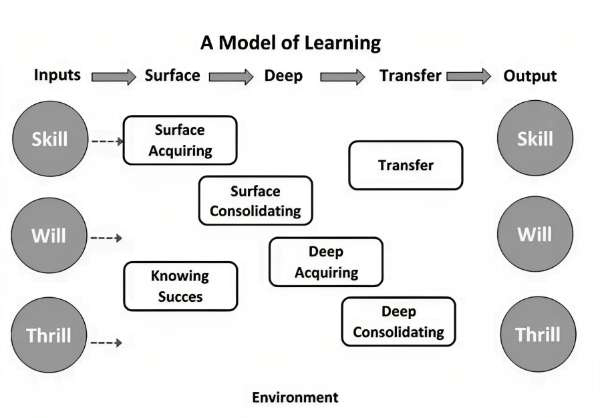
Building upon this foundation, research has revealed that learning comprises distinct stages, each with its unique characteristics and challenges (Hattie and Donoghue, 2016). Hattie and Donoghue (2016) introduced a model based on a synthesis of 228 metaanalyses, suggesting that different learning strategies are effective at specific stages of the learning cycle. The initial stage is acquisition, where individuals encounter and encode new information or skills (Schunk, 2012). This phase lays the groundwork for subsequent learning phases. Following acquisition, the consolidation phase comes into play, involving the solidification of knowledge through repetition and practice (Roediger & Karpicke, 2006). Repetition serves to embed information into long-term memory. The subsequent stage, transfer, entails the application of acquired knowledge or skills in novel contexts (Perkins & Salomon, 1992). It is during this phase that learners demonstrate their ability to adapt and utilise what they've learned beyond the initial context. Finally, metacognition, characterised by evaluating one's learning and promoting self-regulation (Flavell, 1979), plays an integral role. Here, individuals reflect on their learning process, enhancing their ability to monitor and adjust their approach for more effective learning. The iterative cycles of design, testing, and refinement in this framework reinforce the value of failures as an integral part of the learning process (Penuel & Gallagher, 2009). Importantly, the model emphasises that educators should prioritise learning over grades and equip students with learning strategies and skills. It encompasses three dimensions: skill (knowledge and ability), will (student dispositions affecting learning), and thrill (motivation, emotions, and enjoyment of learning). This perspective underscores that learning and achievement are related rather than opposing concepts. In addition, student motivation emerges as a pivotal factor. Intrinsic motivation, characterised by internal drive and genuine interest, often leads to enhanced performance and better retention. It fuels the learning engine, motivating individuals to engage more deeply with the material. Additionally, emotions, engagement, attitudes, and personal experiences also play a crucial role in the learning process (Harju et al., 2019). These factors influence the learner's level of interest, attention, and overall cognitive engagement, ultimately impacting the encoding and retention of information. However, there are obstacles to learning that can hinder or impede the learning process. Here are four key barriers to learning based on principles from behavioural economics (Lavecchia et al., 2016)

The Pedagogy-Of-UnBox

Students from different schools in Jammu & Kashmir engaged in diverse activities.
UnBox offers age-specific editions with a curriculum that encourages children to complete two weekly exercises, guided by facilitators in schools. Over the academic year, it engages students in 40 activities designed to promote diverse thinking rather than just craftsmanship. The focus is on self-directed learning, fostering autonomy and encouraging questions about why, what, and how to learn. This iterative process requires curiosity and the ability to connect seemingly unrelated ideas, aligning with Foster's insights. UnBox's creative approach helps participants explore emotions, empathize with others, and cope with unresolved issues, ultimately striving to enhance their humanity. Through sensory kinaesthetic activities, participants engage in कला-कसरत, creating spaces for emotional expression. The handcrafted materials embrace imperfections, cultivating a more organic connection with the program's elements. UnBox promotes the beauty of interdependence and empowers participants to construct their own answers, find their own paths, and take ownership of their journeys. Finally, it reinforces core human qualities such as happiness, empathy, patience, sensitivity, expression, and companionship as foundational aspects of learning.
UnBox is a transformative program that recognizes the uniqueness of every child, fostering their learning abilities and encouraging independent thinking and expressive power. It empowers children to identify their own learning pace, with the program typically spanning 6 to 10 months, depending on the interval between two "कला-कसरत" sessions, which are ideally spaced at 7 days but can be adjusted with a minimum of 3 days between activities. These sessions are guided by playful instructions in the native language, utilizing UnBox-provided speakers. The program's materials include individualized activity collaterals and worksheets, alongside shared tools like stationery and art supplies. In essence, UnBox's "कला-कसरत" initiative is designed to nurture creative and critical thinking in children, promoting autonomy, inquiry, and imaginative exploration, thereby shaping lifelong learners equipped with creativity and an open-minded approach to challenges.
Learning Model and Core learning attributes of UnBox
The UnBox uses the “Four Stage Model of Creativity” as proposed by psychologist Graham Wallas and later by numerous other experts which focuses on the cognitive processes involved in creativity.

The Study in Jammu
A study was conducted in Jammu to assess the effectiveness of the UnBox Toolkit.
Study design and population
For this study, 4 schools were selected from the Jammu region. 115 students from three schools formed the intervention group. Amongst the intervention group 64 students appeared for both, the baseline and endline, tests. Whereas 26 from the 49 students in the control group appeared for the Baseline and Endline tests. The learning levels of students from both the groups were determined by a baseline study conducted at the outset. Various components of the three skills – Inquisitiveness, Analysis, Innovation – were measured at the beginning. The intervention group was then given exposures of 12 exercises at an interval of two days between two exercises. At the end of the 12 exercises, an Endline test was conducted for both the groups. The comparative scores between these two groups gave a clear view of the impact of UnBox.
UnBox is a transformative program that recognizes the uniqueness of every child, fostering their learning abilities and encouraging independent thinking and expressive power. It empowers children to identify their own learning pace, with the program typically spanning 6 to 10 months, depending on the interval between two "कला-कसरत" sessions, which are ideally spaced at 7 days but can be adjusted with a minimum of 3 days between activities. These sessions are guided by playful instructions in the native language, utilizing UnBox-provided speakers. The program's materials include individualized activity collaterals and worksheets, alongside shared tools like stationery and art supplies. In essence, UnBox's "कला-कसरत" initiative is designed to nurture creative and critical thinking in children, promoting autonomy, inquiry, and imaginative exploration, thereby shaping lifelong learners equipped with creativity and an open-minded approach to challenges.

Map shows the location of various selected schools for the study
Exploring Subjectivity in Accounting: Delphi Process Test Study Results
The assessment of students on a given skill set by experts involves subjective elements. Hence, it was essential to minimise the subjectivity in the evaluation to assess the real impact of UnBox. To address this, the selected experts evaluated a sample set of 20 participants on the questionnaire independently. Cohen’s kappa coefficient was obtained as a measure of agreement among the experts on the three skill sets. In the case of moderate/fair/poor agreement (Kappa coefficient < 0.60), a Delphi approach was adopted, wherein experts discussed face-to-face and resolved the subjective aspects. The exercise ensured setting up definite evaluation criteria and the rationale for unbiased assessment. Subsequently, the experts evaluated another random set of 20 participants, referring to the set criteria and again, the Kappa coefficient was determined. The coefficient exceeded 0.60, and the evaluation system was used in real-time.
Prior to conducting the pilot study under consideration, the School of Creativity in Nagpur, the creator UnBox, conducted a test study over the last week of March 2023. This aimed to investigate how the Delphi process can help build consensus among subject experts of the panel to remove the subjectivity bias. To help develop professional guidelines for an effective assessment of outcomes. The test study comprised a systematic, interactive method and a panel of three qualified experts. It was conducted in two stages.
In stage one, the facilitator briefed the panel members about the guidelines for analysing the creations, for quantifying the scoring methodologies. This structured group of subject experts were asked to analyse the creations of student participants individually. Thereafter, the facilitator provided an anonymized summary of the experts’ marking as well as the guidelines they provided for their judgments. The initial contributions from the experts were collected in the form of answers to a questionnaire. The facilitator controlled the interactions among the participants by processing the information and filtering out irrelevant contents. This stage showed a consensus of 60 percent among the panel members.
In stage two, the facilitator briefed the panel members about the method in detail by setting up norms to analyse the creations. The same process of analysing and marking was repeated in the second stage. The range of the answers decreased and the group converged towards the consensual answer. The study of the second step showed 90 percent consensus amongst the panel members. The process was stopped after a predefined stop criterion of ‘the achievement of the maximum consensus’.
Understanding the Proposed Analysis Method
Initially, student scores assigned by three experts were averaged to determine skill levels. Descriptive statistics, including mean, median, standard deviation, minimum, and maximum, were calculated for baseline scores. Statistical significance between control and intervention groups was assessed using the Mann-Whitney U test. The intervention group received training as per the defined protocol, while the control group did not. Post-intervention, both groups were re-evaluated, and scores compared between and within the groups using statistical tests, including the Wilcoxon signed rank test. All analyses were conducted using SPSS ver 26.0 software, with a significance level set at 5%.
Baseline
Scholastic excellence, while important, is not enough for breakthrough innovations. Unlearning, the capacity to break free from rigid ideas while retaining academic knowledge, fosters flexibility in thinking, leading to unconventional solutions—an essential trait for innovation. This activity evaluates one's ability to seek fluid solutions, showcasing lateral thinking and innovation. Innovators often explore out-of-the-box approaches, even when obvious solutions are available, all while maintaining a sense of purpose.
The assessment focuses on three hey criteria: 1.Unconuentional Approach: Innovation thrives on thinking outside the box and exploring new perspectives. Employing innovative techniques for problem-solving and idea development can lead to unique solutions by challenging limiting assumptions and convictions. By questioning the status quo and asking questions like "why" or "what if," we can open up fresh opportunities for creative thinking. 2. Use of Associationism and Law of Contrast: This criterion evaluates the creation of forms based on similarity and contrast in color. Associationism, which involves how we acquire concepts and associative structures, is considered. The analysis includes three types of associative relations: cause and effect, contiguity, and resemblance. Aristotle's law of contrast emphasizes the importance of relating existing knowledge to new learning, and the assessment measures responses such as assimilation, attention, prepotency of elements, belongingness, and stimulus identifiability. 3.Creating Distinct Meaningful Forms: Forms are categorized as Geometric, Organic, and Abstract, with a focus on those created with a clear understanding of their function. These forms are generated using various elements provided as part of the test.
Endline
The premise of Endline is similar to that of Baseline study. The two parameters of evaluation - Unconventional approach and Number of meaningful forms created, are kept constant in the endline test. The parameter -Use of Basic Shapes is introduced in the endline test.
Use of Basic shapes: The shapes given as part of the test were Square, Circle and a triangle. As compared to any abstract shape, they carry a very definite meaning. Abstract shapes often refer to relationships rather than specific objects; and their meaning is more variable, both within and across subjects. For ex an amoeboid finds its varied applications in a creation owing to its not so definite meaning. This 'fixedness' of basic shapes makes their application a critical task. When children can impart meaning to basic shapes, it is an indicator of the ability to connect the dots critically.
Results
The below tests provide a detailed overview of the statistical analysis and findings from the study conducted in Jammu assessing the impact of the UnBox Toolkit on student learning outcomes.
-
Agreement between the examiners (ICC: Intra-class correlation coefficient)

Table 1: Intra-class Correlation Coefficient (ICC) indicating agreement among examiners at activity 1 (initial activity)

Figure 1: Boxplots showing distribution of scores assigned to students at initial activity.
Table 1 presents data that reflects the agreement among examiners when assessing students in the initial activity of the study conducted in Jammu and Kashmir. The ICC value of 0.935 indicates an exceptionally high level of agreement among the four examiners who evaluated the students. Importantly, this agreement is not merely coincidental; it carries substantial statistical significance (p < 0.001). This demonstrates the robustness and reliability of the assessment process, highlighting that the examiners consistently evaluated students in a nearly identical manner.
2. Analysis of scores

Table 2: Descriptive statistics for scores on activity 1 and activity 14.
Table 2 provides descriptive statistics for student scores in both the initial and final activities, distinguishing between the intervention and control groups in the Jammu study. A total of 115 students from various schools in the region participated in the study, with 64 students in the intervention group and 26 students in the control group. In the initial activity, the mean score for the intervention group was 5.813, with a standard deviation (SD) of 2.721, while the control group had a mean score of 6.385, with an SD of 2.294. Notably, the difference in mean scores between these groups was not statistically significant (p=0.348), indicating that, at the beginning of the study, there were no substantial score disparities between the two groups.
Moving to the final activity, the intervention group achieved a mean score of 9.199, with an SD of 2.663, while the control group attained a mean score of 8.192, with an SD of 2.184. Once again, the distinction in mean scores between the two groups was not statistically significant (p=0.091). These findings suggest that, even after the intervention, there were no significant differences in mean scores between the intervention and control groups.

Table 3: Descriptive statistics for change in scores from activity 1 to activity 14
Table 3 delves into the change in scores from the initial to the final activities within the Jammu study. The data reveals that the intervention group experienced a mean score change of 3.387, with a standard deviation (SD) of 3.081, while the control group exhibited a mean score change of 1.808, with an SD of 2.784. A critical statistical analysis uncovered a significant difference in mean change between these groups, supported by a p-value of 0.026. This particular finding underscores that the intervention group demonstrated a substantial and statistically significant improvement in scores from the initial to the final stage compared to the control group.


Test of Normality and Q-Q plot showing distribution of observations along the diagonal
The table titled "Tests of Normality" verifies that the data collected adheres to the assumption of a normal distribution, a crucial validation step for subsequent statistical analyses. Both the Shapiro-Wilk and Kolmogorov-Smirnov tests confirm that the data follows this assumption, ensuring the reliability of the study's statistical procedures.
3. Adjusted scores at activity 14 using analysis of covariance (ANCOVA)

Table 4: Analysis of covariance
Table 4 offers insights into the results of an analysis of covariance (ANCOVA) conducted to adjust final-stage scores based on initial-stage scores. This analysis unveiled a statistically significant difference between the two groups at the final stage after accounting for initial differences (p=0.039). The adjustment of mean scores is essential for mitigating the impact of any initial variations between the groups.

Table 5: Estimated marginal means after adjusting with baseline score at activity 1
In Table 5, estimated marginal means are presented after incorporating adjustments with baseline scores from the initial activity. Here, the intervention group's adjusted mean at the final stage was 9.251, with a standard error (SE) of 0.302, while the control group displayed an adjusted mean of 8.066 (SE: 0.476). Critically, the adjusted mean for the intervention group at the final stage emerged as significantly higher than that of the control group (p=0.039). These findings strongly reinforce the positive impact of the UnBox Toolkit intervention on student learning outcomes in the Jammu region, even after accounting for any initial differences in scores.
In summary, the comprehensive results of the study conducted in Jammu and Kashmir indicate that the UnBox Toolkit had a significant positive impact on student learning outcomes. This was evidenced by the high level of agreement among examiners, the substantial improvement in scores in the intervention group, and the statistical significance of these findings. These results highlight the toolkit's effectiveness in promoting innovative thinking and problem-solving skills among students, underscoring its potential as a valuable educational resource.
Conclusion and Way ahead...
Learning by doing is a key component of the UnBox Toolkit. It encourages active student engagement and offers opportunities for hands-on learning experiences. Moreover, the use of the UnBox Toolkit promotes interaction and collaboration among students, which are critical for negotiating shared meanings and developing individual reasoning. Through the formalization of an inquiry-based learning approach, the Unbox Toolkit provides a framework that supports the development of student reasoning and sense-making.
Unbox Toolkit holds tremendous potential for enhancing learning outcomes in educational settings. Through the pilot study conducted in Jammu, it has become evident that the toolkit can positively impact student learning outcomes. It encompasses a range of innovative teaching and learning strategies that cultivate critical thinking, problem-solving, and creativity among students. Additionally, the results of this study provide a strong foundation for further research and implementation of the UnBox Toolkit in other educational contexts.
Moving forward, it is recommended to further explore the long-term effects of the UnBox Toolkit on student learning outcomes. Understanding the psychology of students and their receptiveness to the toolkit can provide valuable insights for designing and implementing future interventions. Replicating this study in various regions with different educational contexts allows for an assessment across diverse settings. To ensure continuous improvement, feedback from both teachers and students should play an integral role in the development and refinement of the toolkit.
In a classroom setting where resources such as time, funds, supplies, and educators are limited, it becomes crucial to implement interventions that are both cost-effective and empirically supported. This ensures optimal use of available resources while maximizing student outcomes. By synthesising insights from psychology, neuroscience, and sociology, behavioural economics has provided valuable perspectives on learning.
These interventions address behavioral challenges and improve learning outcomes, with various strategies rooted in behavioral economics having been developed. It is important to consider several factors that significantly shape learning and decision-making processes, such as sensory experiences, cognitive load, and socio-emotional influences (Schwartz, 2004). Furthermore, socio-emotional contexts play a pivotal role in decision-making, particularly in long-term planning scenarios (Guiso, Monte, Sapienza, & Zingales, 2008). Educators also have a crucial role to play in addressing the challenges posed by behavioral tendencies, such as present bias, reliance on familiar routines, overlooking less noticeable information, and the formation of negative self-identities ("Handbook of the Economics of Education," 2016).
In light of these complexities, there is a compelling need to integrate behavioural economics into educational interventions. Such an approach holds the potential to develop more effective tools and interventions that optimise educational decisions, support individual success, and enhance overall educational welfare.
Looking ahead, the application of behavioural economics to education offers promising avenues for improving educational decisions and outcomes. Designing targeted interventions to mitigate these barriers, with experimental methods for testing and evaluation, holds immense potential. The overarching objective should be to foster improved long-term educational outcomes, ultimately enhancing the welfare of students. Continued research is imperative to gain a deeper understanding of the sociopsychological underpinnings of choices in learning, to enable the formulation of evidence-based educational interventions.
Bibliography
Works Cited
A Design Model for Educational Multimedia Software https://www.scirp.org/(S(351jmbntvnsjt1aadkposzje))/reference/ReferencesPapers.aspx?ReferenceID=1368505
Application of Behavioral Economics to Education https://academiccommons.columbia.edu/doi/10.7916/xspp-n668/download
Arts in Education: A Systematic Review of Competency Outcomes in Quasi-Experimental and Experimental Studies Frontiers | Arts in Education: A Systematic Review of Competency Outcomes in Quasi-Experimental and Experimental Studies (frontiersin.org)
Behavioral Economics of Education: Progress and Possibilities https://scholarship.law.upenn.edu/faculty_scholarship/2516/
Child Development and Arts Education: A review of Current Research and Best Practices ( College Board for The National Coalition for Core Arts Standards 2012) College Board Research - Child Development Report.pdf (nationalartsstandards.org)
Children’s education in ‘good’ nature: Perceptions of activities in nature spaces in mobile preschools https://journals.sagepub.com/doi/10.1177/2043610619900519
Communities of Making - A Visual Exploration of Rural Makerspaces in India https://link.springer.com/chapter/10.1007/978-981-19-4472-7_118
Creativity, innovation, and cross-cultural collaboration in atal innovation mission https://www.tandfonline.com/doi/abs/10.1080/00094056.2021.1982294?journalCode=uced20
Design-based education, sustainable teaching, and learning https://www.tandfonline.com/doi/pdf/10.1080/2331186X.2019.1647919
Educational leadership and management:theory, policy, and practice https://files.eric.ed.gov/fulltext/EJ1150205.pdf
Every day creativity in daily life: An experience-sampling study of “little c” creativity. (Silvia, P. J., Beaty, R. E., Nusbaum, E. C., Eddington, K. M., Levin-Aspenson, H., & Kwapil, T. R. - 2014)
From game design elements to gamefulness: defining "gamification" https://dl.acm.org/doi/10.1145/2181037.2181040
Learning about Learning https://www.jstor.org/stable/3446159
Learning strategies: a synthesis and conceptual model https://www.nature.com/articles/npjscilearn201613
Metacognition and cognitive monitoring: A new area of cognitive–developmental inquiry. https://psycnet.apa.org/record/1980-09388-001
Mindspark In Rajasthan: Personalized Adaptive Learning Tools To Improve Learning Outcomes https://www.povertyactionlab.org/sites/default/files/2019.11.13-JPAL-Mindspark.pdf
Mindspark: Improving Educational Outcomes in India https://ei.study/wp-content/uploads/2023/02/Mindspark_Harvard-Business-School_Case-Study-1.pdf
Nudging in education: from theory towards guidelines for successful implementation https://www.researchgate.net/publication/343845395_Nudging_in_education_from_theory_towards_guidelines_for_successful_implementation#:~:text=Nudging%20is%20one%20of%20the,in%20education%20is%20yet%20sparse.
Pre-Service Teachers’ 3D Visualization Strategies https://www.scirp.org/(S(351jmbntvnsjt1aadkozje))/reference/referencespapers.aspx?referenceid=1503339
Project DEFY - Nooks https://www.edexlive.com/people/2018/nov/09/people-of-this-village-near-bengaluru-are-super-tech-savvy-thanks-to-abhijit-sinhas-project-defy-n-4381.html
Researching student agency in digital education as if the social aspects matter: students’ experience of participatory dimensions of online peer assessment https://www.tandfonline.com/doi/abs/10.1080/02602938.2020.1798355
Self organising systems for mass computer literacy: Findings from the ‘hole in the wall’ experiments https://www.emerald.com/insight/content/doi/10.1108/eb045849/full/html
Self-Designed Learning in Nooks: Exploring alternatives to mainstream education https://www.tandfonline.com/doi/abs/10.1080/00094056.2021.1982294?journalCode=uced20
Test-enhanced learning: Taking memory tests improves long-term retention. https://psycnet.apa.org/record/2006-05194-012
The Arts Need to Be a Central Part of Schooling (Mariale Hardiman — October 02, 2017) The Arts Need to Be a Central Part of Schooling (Opinion) (edweek.org)
The influence of teaching learning techniques on students’ long-term learning behavior https://www.tandfonline.com/doi/abs/10.1080/09588221.2019.1567557
Using Arts Education to Help Other Lessons Stick (The New York Times By Perri Klass, M.D.) Using Arts Education to Help Other Lessons Stick - The New York Times (nytimes.com)
Using Hirvela’s Reading/Writing Connections as a Tool for the Evaluation of Academic Writing Courses https://www.scirp.org/%28S%28lz5mqp453edsnp55rrgjct55%29%29/reference/referencespapers.aspx?referenceid=3014151
